

Traditional local hiring models are rapidly becoming a financial liability for growing U.S. businesses. Recent industry data indicates that companies are seeing an average cost reduction of 50% or more by shifting to nearshore staffing solutions in Mexico. This shift is not merely about saving money. It is about accessing a bilingual, college-educated workforce that operates in the same time zone as your headquarters. For operational support roles, this model eliminates the communication delays and cultural friction that often plague traditional offshore outsourcing. (IT Services 8211 GDL)
Why Local Hiring Fails for Scaling Operations
Operational support roles, including administrative assistance, data entry, and customer service, are the backbone of any efficient business. However, hiring these roles locally in major U.S. metropolitan areas presents significant challenges. The primary issue is the escalating cost of labor. Salaries in cities like New York, San Francisco, or Chicago have risen sharply, making it difficult to maintain healthy profit margins on support functions.
Beyond cost, the talent pool is increasingly competitive. Local companies often struggle to find qualified candidates who are both skilled and available. This leads to prolonged hiring cycles and increased overhead for recruitment and onboarding. Furthermore, local hires may lack the specific bilingual capabilities required for diverse customer bases or international supply chains.
Many business leaders assume that hiring locally ensures better communication and cultural alignment. While this is partially true, it ignores the logistical benefits of geographic proximity combined with cultural compatibility. The traditional model forces a choice between high costs and limited talent. A better alternative exists that breaks this binary choice.
The Nearshore Advantage Explained
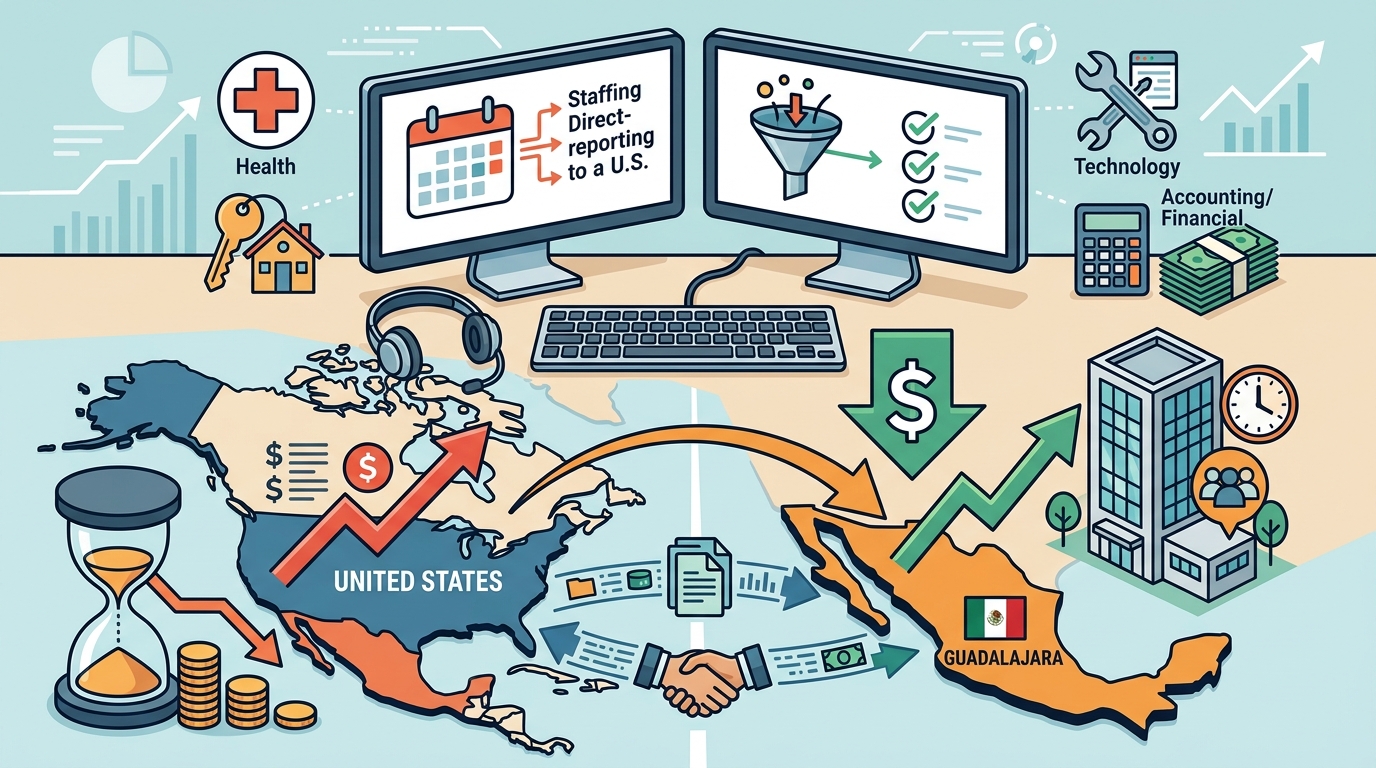
Nearshoring involves relocating business processes to a neighboring country with similar time zones and cultural affinities. For U.S. companies, Mexico is the premier nearshore destination. This model offers a unique combination of cost efficiency, operational continuity, and talent quality.
Nearshoring is the strategic practice of moving business operations to a nearby geographic region to reduce costs while maintaining operational control and communication efficiency. Unlike offshore outsourcing to distant regions, nearshoring ensures that your team works during standard U.S. business hours. This real-time collaboration is critical for operational support roles that require immediate response times and dynamic problem-solving.
Guadalajara, Mexico, has emerged as a leading hub for this model. The city boasts a robust ecosystem of tech and professional services talent. Professionals in this region are often bilingual, college-educated, and trained in U.S. business practices. This reduces the training burden on your internal team and accelerates time-to-productivity.
According to recent workforce analyses, nearshore teams in Mexico offer a significant competitive edge. They provide the same level of professionalism and skill as local hires but at a fraction of the cost. This allows U.S. companies to scale their operations rapidly without the financial strain of local wage inflation.
Cost Comparison: Local vs. Nearshore
Understanding the financial impact of your hiring strategy is crucial. The cost differential between local U.S. hires and nearshore professionals is substantial. This is not just about hourly wages. It includes benefits, payroll taxes, office space, and equipment.
| Cost Factor | Local U.S. Hire | Nearshore Hire (Mexico) | Savings Potential |
|---|---|---|---|
| Base Salary | High (Market Rate) | Low to Moderate | Up to 50% |
| Payroll Taxes & Benefits | Significant Overhead | Managed by Partner | Reduced Complexity |
| Recruitment Costs | High (Agency Fees) | Lower (Sourcing Included) | Faster Placement |
| Operational Continuity | Standard Hours | Same Time Zone (CST) | Real-Time Collaboration |
The data shows that the total cost of ownership for a nearshore team is significantly lower. This is because nearshore staffing partners handle the complexities of HR, payroll, and local compliance. This allows your internal team to focus on core business activities rather than administrative burdens.
Furthermore, the quality of talent in Mexico is often superior to what is available locally for the same price point. Many professionals in Guadalajara have degrees in business, administration, and technology. They are accustomed to working with U.S. clients and understand the nuances of American business culture. This reduces the risk of miscommunication and errors in operational support tasks.
Ideal Roles for Nearshoring
Not every role is suitable for nearshoring. However, operational support roles are among the best candidates for this model. These roles are often repetitive, process-driven, and require high levels of accuracy and availability.
Administrative support is the coordination of daily business tasks, including scheduling, correspondence, and document management, to ensure smooth organizational flow. These tasks are ideal for nearshore teams because they can be performed remotely with minimal supervision. Virtual assistants, executive assistants, and office managers can seamlessly integrate into U.S. workflows.
Other ideal roles include:
- Accounting and Finance Support: Bookkeeping, accounts payable/receivable, and financial reporting. Nearshore accountants are often certified and fluent in U.S. GAAP standards.
- Customer Service and Operations: Live chat support, email handling, and order processing. Same-time-zone availability ensures that customers receive timely assistance.
- IT and Technical Support: Help desk services, cloud management, and software development. Guadalajara is a tech hub with a deep pool of skilled developers and IT professionals.
- Healthcare Administration: Patient scheduling, billing, and insurance verification. Bilingual staff can effectively serve diverse patient populations.
By identifying these roles, you can create a targeted nearshoring strategy. This approach allows you to scale specific departments without expanding your local footprint. It also provides flexibility to adjust team size based on seasonal demand or business growth.
Implementation Strategy
Transitioning to a nearshore model requires a structured approach. It is not simply about hiring foreign workers. It is about building a cohesive team that operates as an extension of your organization.
The first step is to define your operational needs. Identify which roles are most critical to your business and which are best suited for remote support. Create detailed job descriptions that outline expectations, required skills, and performance metrics. This clarity is essential for attracting the right talent.
Next, partner with a reputable nearshore staffing provider. Look for a company that specializes in your industry and offers comprehensive support services. This includes recruiting, HR administration, payroll, and employee engagement. A strong partner will handle the legal and compliance aspects of hiring in Mexico, reducing your risk and liability.
Integration is the final and most critical phase. Establish clear communication channels and workflows. Use project management tools to track progress and ensure accountability. Regular check-ins and feedback loops will help your nearshore team align with your company culture and goals.
Workforce management is the ongoing coordination of employee performance, engagement, and development to ensure long-term team success and operational efficiency. By investing in strong workforce management practices, you can maximize the value of your nearshore team and drive sustainable growth.
Key Takeaways
- Nearshoring to Mexico offers up to 50% cost reduction compared to local U.S. hiring.
- Guadalajara is a leading hub for bilingual, college-educated professionals.
- Same-time-zone collaboration eliminates communication delays associated with offshore outsourcing.
- Operational support roles like admin, accounting, and IT are ideal for nearshoring.
- Partnering with a staffing provider handles HR, payroll, and compliance complexities.
- Access to a larger talent pool reduces hiring bottlenecks and time-to-fill.
- Scalability is improved, allowing businesses to adjust team size based on demand.
Frequently Asked Questions
Is nearshoring to Mexico legal and compliant?
Yes, nearshoring is a fully legal and compliant business practice. When you partner with a local staffing provider, they handle all Mexican labor laws, tax obligations, and employment regulations. This ensures that your business remains compliant without the administrative burden.
How does time zone alignment work with Mexico?
Most of Mexico, including Guadalajara, operates in the Central Standard Time (CST) zone, which is the same as many major U.S. cities. This allows for real-time collaboration and immediate response to operational needs.
What types of operational roles are best for nearshoring?
Administrative support, accounting, customer service, IT support, and healthcare administration are the most common roles. These positions benefit from the cost savings and talent availability of the nearshore model.
Can nearshore teams integrate with our existing tools?
Absolutely. Nearshore professionals are trained to use standard U.S. business tools such as Slack, Zoom, Salesforce, and various cloud-based platforms. This ensures seamless integration into your existing workflows.
How do I ensure quality control with a remote team?
Quality control is maintained through clear performance metrics, regular communication, and the use of project management software. A good staffing partner will also provide ongoing HR support to ensure employee engagement and performance.
What is the typical onboarding process?
Onboarding usually involves a structured training program provided by the staffing partner, followed by integration into your company's specific processes. This typically takes a few weeks to ensure the team is fully productive.
Is data security a concern with nearshoring?
Data security is a top priority for reputable nearshore providers. They implement strict cybersecurity protocols, non-disclosure agreements, and compliance standards to protect your sensitive business information.
Start Building Your Team
The best alternative to hiring locally for operational support is nearshoring to Mexico. It offers a proven path to cost savings, talent access, and operational efficiency. GDL Connect specializes in helping U.S. businesses build high-performing teams in Guadalajara. We provide tailored staffing solutions that align with your growth objectives.
Do not let local hiring constraints hold your business back. Schedule a consultation with GDL Connect today to explore how we can help you scale your operations. Visit our Industry Solutions page to learn more about our specialized services. Explore our About Us page to understand our commitment to excellence. Read our latest insights on the Blog for actionable tips. Discover our Finance and Healthcare staffing expertise. Book a Free Strategy Call now to transform your workforce.