

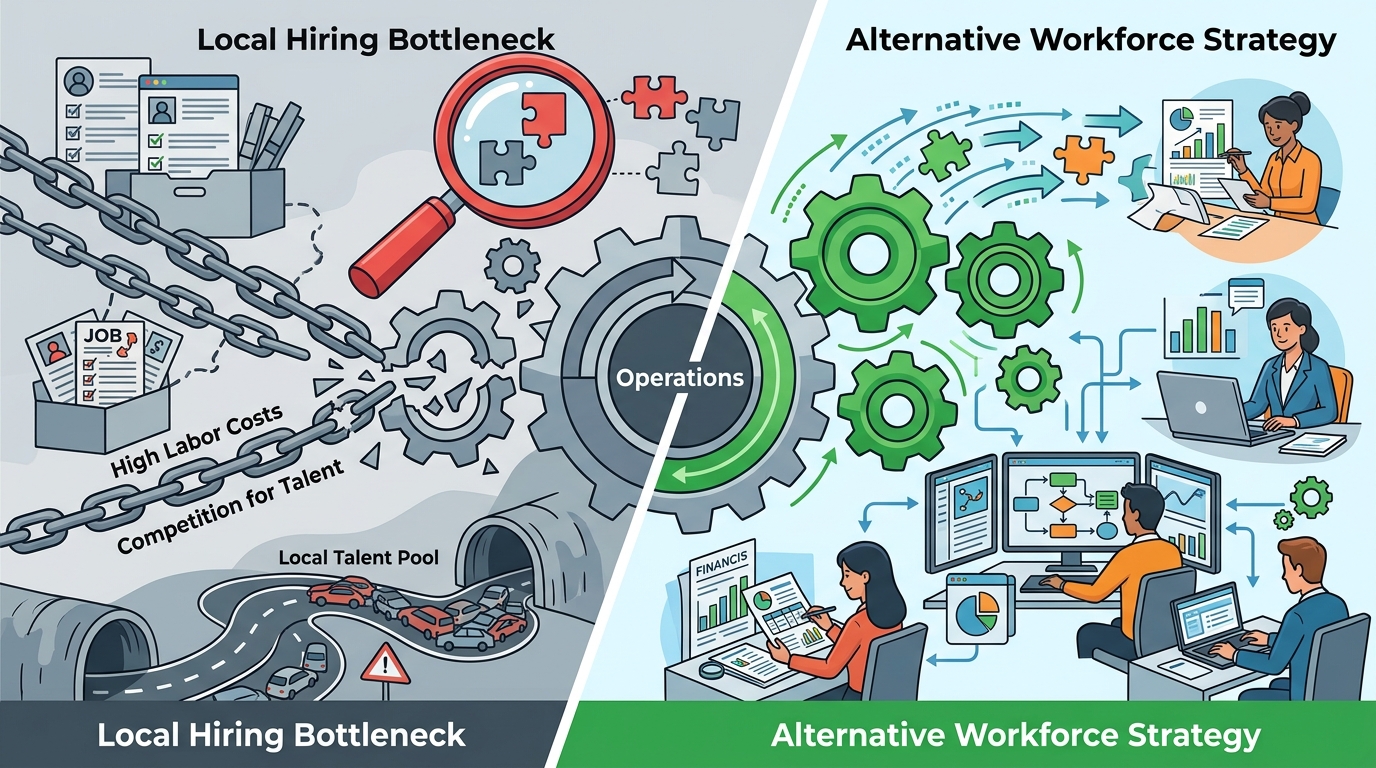
Traditional local hiring for operational support roles is facing a critical bottleneck. Rising labor costs and intense competition for specialized talent are forcing U.S. companies to rethink their workforce strategies. According to recent industry data, organizations are seeing a 50% reduction in hiring costs by shifting to nearshore models in Mexico. This shift is not just about saving money; it is about gaining access to a highly educated, bilingual workforce that aligns with U.S. business hours. (About Us 8211 GDL)
Why Local Hiring Fails for Scaling Teams
Operational support roles, such as administrative professionals, customer support representatives, and transaction coordinators, are the backbone of any growing business. However, hiring these roles locally in the United States presents significant challenges. The primary issue is the escalating cost of labor. Salaries, benefits, and overhead expenses in major U.S. cities have skyrocketed, making it difficult for mid-sized companies to maintain healthy margins. (GDL Connect 8211 GDL)
Furthermore, the talent pool for these roles is shrinking. Competition for skilled administrative and operational staff is fierce, leading to longer time-to-hire metrics. Companies often spend weeks or months searching for the right candidate, during which time operational efficiency suffers. This delay can stall growth initiatives and create bottlenecks in critical workflows. (Blog 8211 GDL Connect)
Another hidden cost is the burden of human resources management. Local hiring requires companies to manage payroll, benefits administration, and regulatory compliance themselves. This administrative overhead diverts leadership focus away from core business objectives. As a result, many U.S. companies are seeking a more efficient alternative that offers both cost savings and operational control. (Finance 8211 GDL Connect)
The Nearshore Advantage Explained
Nearshoring to Mexico has emerged as the superior alternative to local hiring for operational support. Nearshoring involves building dedicated teams in a neighboring country with similar time zones and cultural affinities. For U.S. businesses, Mexico offers a unique combination of geographic proximity, time zone alignment, and a highly educated workforce.
One of the most significant benefits of nearshoring is the same-time-zone collaboration. Professionals in Mexico typically work in the Central Standard Time (CST) zone, which allows for real-time communication with U.S. teams. This alignment eliminates the delays associated with offshore outsourcing to Asia or Eastern Europe, where time differences can hinder productivity and decision-making speed.
Additionally, nearshoring provides access to top-tier talent. Mexico has a growing professional workforce with strong English proficiency and cultural compatibility with the United States. This makes it easier for nearshore teams to integrate seamlessly into U.S. business operations. The result is a workforce that feels like an extension of the internal team, rather than an external vendor.
Cost efficiency is another major driver. By leveraging nearshore staffing, companies can reduce operational expenses by up to 50% compared to U.S. hiring. This cost reduction is achieved without sacrificing quality or performance. Instead, companies gain access to college-educated, bilingual professionals who are eager to contribute to their organization's success.
Key Operational Roles to Nearshore
Not all roles are equally suited for nearshoring, but operational support functions are ideal candidates. These roles are often process-driven and can be effectively managed remotely with the right infrastructure. Below are some of the most common operational roles that U.S. companies successfully nearshore.
Administrative Professionals
Administrative professionals handle scheduling, correspondence, and general office management. These roles are highly transferable to a nearshore model. Bilingual administrative staff in Mexico can manage complex calendars, coordinate meetings across time zones, and handle client communications with ease. This allows U.S. executives to focus on strategic initiatives rather than administrative tasks.
Customer Support Representatives
Customer support is a critical function that requires quick response times and empathy. Nearshore teams in Mexico can provide 24/7 support coverage by leveraging their time zone alignment with the U.S. This ensures that customers receive timely assistance, improving satisfaction and retention rates. The cultural compatibility of Mexican professionals also enhances the quality of customer interactions.
Transaction Coordinators
In industries like real estate and finance, transaction coordinators manage the paperwork and logistics of deals. These roles require attention to detail and adherence to strict deadlines. Nearshoring transaction coordination allows U.S. firms to scale their operations without increasing local headcount. Dedicated teams in Mexico can handle document management, client communication, and compliance checks efficiently.
Accounting and Finance Staff
Accounting professionals, including bookkeepers and financial analysts, are increasingly being nearshored. These roles require precision and confidentiality, which nearshore staffing providers ensure through robust HR and payroll administration. By hiring dedicated accounting teams in Mexico, U.S. companies can reduce costs while maintaining high standards of financial accuracy.
Compliance and Infrastructure
One of the biggest concerns for U.S. companies considering nearshoring is compliance and infrastructure. Managing payroll, benefits, and labor laws in a foreign country can be complex and risky. This is where a dedicated nearshore partner becomes invaluable.
A reputable nearshore staffing provider handles all aspects of HR, payroll, and administrative support locally in Mexico. This includes ensuring compliance with Mexican labor laws, managing employee benefits, and providing ongoing support to the nearshore team. By offloading these responsibilities, U.S. companies can focus on managing their team's performance and strategic goals.
Infrastructure is another critical component. Nearshore partners provide the necessary facilities, equipment, and engagement tools to ensure that the dedicated team can work effectively. This includes secure IT infrastructure, reliable internet connectivity, and access to the software and platforms required for the role. This setup ensures that the nearshore team is fully integrated and productive from day one.
Furthermore, nearshore staffing providers offer ongoing employee support and retention initiatives. This helps to build stable, high-performing teams that contribute to long-term business growth. By investing in the professional development and engagement of their nearshore staff, providers ensure that clients receive consistent, high-quality service.
Comparing Hiring Models
To understand why nearshoring is the best alternative to local hiring, it is helpful to compare it with other workforce models. Each model has its own set of advantages and disadvantages, depending on the specific needs of the business.
| Hiring Model | Cost Efficiency | Time Zone Alignment | Talent Quality | Operational Control |
|---|---|---|---|---|
| Local U.S. Hiring | Low | Perfect | High | Full |
| Nearshore (Mexico) | High | Same (CST) | High | Full |
| Offshore (Asia/Eastern Europe) | Very High | Poor | Moderate | Limited |
| Freelance Platforms | Moderate | Variable | Variable | Limited |
As shown in the table above, nearshoring offers the best balance of cost efficiency, time zone alignment, and operational control. While offshore outsourcing may offer lower costs, the time zone differences and cultural barriers can hinder productivity. Local hiring offers perfect alignment but at a significantly higher cost. Nearshoring provides a middle ground that maximizes value for U.S. businesses.
Key Takeaways
- Cost Savings: Nearshoring to Mexico can reduce hiring costs by up to 50% compared to local U.S. hiring.
- Time Zone Alignment: Mexico operates in the Central Standard Time (CST) zone, enabling real-time collaboration with U.S. teams.
- Talent Quality: Access to a highly educated, bilingual workforce with strong cultural compatibility.
- Operational Control: Unlike traditional outsourcing, nearshore teams work exclusively for your business, ensuring full control.
- Compliance Support: Dedicated partners handle HR, payroll, and legal compliance, reducing risk for U.S. companies.
- Scalability: Easily scale your team up or down based on business needs without the constraints of local labor markets.
- Speed to Hire: Nearshore staffing providers can identify and onboard qualified candidates faster than traditional local hiring.
Frequently Asked Questions
What is nearshoring?
Nearshoring is the practice of relocating business processes or services to a neighboring country with similar time zones and cultural affinities. For U.S. companies, this typically means hiring talent in Mexico.
How much can I save by nearshoring operational roles?
Companies can save up to 50% on hiring costs by nearshoring operational support roles to Mexico. This includes savings on salaries, benefits, and overhead expenses.
Is it legal to hire employees in Mexico from the U.S.?
Yes, it is legal, but it requires compliance with Mexican labor laws. Working with a nearshore staffing provider ensures that all legal and regulatory requirements are met, including payroll and benefits administration.
What types of operational roles are best for nearshoring?
Administrative professionals, customer support representatives, transaction coordinators, and accounting staff are ideal roles for nearshoring. These positions are process-driven and can be effectively managed remotely.
How does time zone alignment benefit my team?
Same-time-zone collaboration allows for real-time communication, faster decision-making, and seamless integration with your U.S. team. This eliminates the delays associated with offshore outsourcing.
Do I have full control over my nearshore team?
Yes, unlike traditional outsourcing, your nearshore team works exclusively for your business. You have full operational control over their tasks, schedules, and performance.
How do I get started with nearshoring?
Start by scheduling a consultation with a nearshore staffing provider. They will help you identify your staffing needs, source qualified candidates, and manage the onboarding process.
Start Building Your Team
Stop letting local hiring constraints hold your business back. Discover how GDL Connect can help you build a dedicated, high-performing team in Mexico. Schedule a Free Strategy Call today to learn more about our nearshore staffing solutions.